I approached the Otto Link LA expecting a variation on a theme. Every other piece in the current JJ Babbitt (JJB) lineup, the Tone Edge, the FL Tone Edge, the FL STM, carries an explicit lineage back to a historical Otto Link. The LA does not. After exchanging emails directly with JJB President Steve Rorie, I can say with confidence that the LA was never meant to continue Otto Link history. It was built to depart from it.
What the Otto Link LA Is
The LA is the most focused, most cutting, and perhaps the most brilliant piece in the current Tone Edge and STM lines. It plays with real energy at the top end without losing the low register warmth that defines the Link core. Relative to a standard Otto Link, the chamber is smaller, sized medium rather than the larger chambers typical of the Tone Edge and STM lines, and the baffle sits higher. That combination is what gives the LA its cut. The defining feature on top of that is a two-baffle geometry, one rollover close to the tip rail and a second roughly half an inch back. This is a deliberate departure from the single clam-shell baffle found in earlier Babbitt designs like the Early Babbitt. It gives the player access to brightness and projection on demand, while the piece still settles into a familiar Link character at soft to medium dynamics.
Where the Design Came From
Mr. Rorie conceived the LA in response to years of player requests for something brighter, bolder, and louder than anything in the standard JJB catalog. He worked through the concept with Chris French and Mike Smith, the two players who ultimately provided prototype feedback as the design took shape. The goal from the outset was narrow. The team wanted extra energy and focus available when a player wanted it without abandoning the core identity of an Otto Link.
Rorie’s own musical references for the sound were Tower of Power and Earth, Wind and Fire. He describes that as a west coast sound, and it is the source of the name. His son Trace came up with LA in support of that goal.
This detail matters because it settles a question I could not answer from marketing alone. The LA is not an homage to a specific historical mouthpiece or era. Rorie was direct about this. He views the LA as a departure from the known historical performance and character of legacy Otto Links.
From Rubber Core to Metal Piece
The rubber LA core was CNC made and then hand perfected by Chris French, well before JJB’s partnership with Theo Wanne existed. That original core, along with a CT scan of a finished piece, was provided to Matt Ambrose and Theo Wanne during early discussions. It was this piece, not a new concept pitched from scratch, that sparked the conversation that eventually became the full JJB and Theo Wanne partnership.
The LA STM’s internal geometry was created from a 3D scan of that same LA Tone Edge core. Fine tuning of the metal piece was left to Theo and Matt, but the stated goal across both materials was reasonable continuity between the rubber and metal versions. Rorie credits the metal piece’s design specifically to Theo and Matt, not to JJB. The LA STM is not a separate design wearing the same name. It is the same core concept translated into metal, with adjustments made by the people who built it.
What Changed and What Did Not
Early units of the rubber LA drew some inconsistency concerns. It would be easy to assume the current version fixed this through manufacturing precision alone. That is only part of the story.
One real design change did happen, deliberately. The original core carried a concave table, sometimes called the belly, long treated as central to Meyer and Otto Link heritage. Theo Wanne understood that history but disagreed that the concave table meaningfully improved the piece’s playing character. Rorie and his son were nervous about removing a feature carrying that much weight in the vintage Link identity, but they trusted Theo’s expertise. The table on the current LA is flat. Rorie says Theo’s judgment proved correct, and JJB no longer has to defend the concave table as essential. He counts the flat table among the real upgrades in the current piece, not a manufacturing correction.
Beyond the table, the underlying core geometry carries forward from the original. What changed is who machines the facing curve, the tip, the tip rail, and the blending from baffle to floor. JJB’s tip line technicians now perform that work after direct training from Theo Wanne, and Matt Ambrose has personally reviewed their technique, measurement, and repeatability in the JJB shop. Rorie credits the resulting accuracy and repeatability directly to Theo and Matt. The gain is that every piece now reaches a higher, more consistent ceiling than the original molded pieces achieved.
My Own Time With It
I have played the LA STM extensively. It sits beyond the FL Tone Edge and the FL STM in this lineup, more focused than either, without drifting into a one-dimensional brightness. It is versatile enough for any jazz player in any situation, delivering more energy and cut without losing the Link identity underneath it.
Human hearing is most sensitive in the upper-midrange, well above where the tenor saxophone’s fundamental pitches sit. A brighter, higher-baffle mouthpiece pushes more energy into that upper range, which is part of why it cuts through in a way a darker piece does not. Electronic amplification solves a related problem, raising volume overall, but it does not change that underlying tonal balance. Working saxophonists without amplification lean on the first approach, and the Otto Link LA is built for exactly that.
A Clean Break, Stated Plainly
The LA does not ask to be measured against the Slant Signature or the Florida Super Tone Master. It was never trying to be either. Rorie’s own framing is the most useful lens available. The history of the Otto Link name does not carry the same weight for many of the players the LA is built for, and JJB built it for the cut and projection those players are actually asking for, which goes beyond the tonal characteristics the brand has historically been known for. That is a rare thing for a company managing a legacy this significant to say plainly, and it is the reason the LA plays differently than everything else in the current lineup.
An earlier Jazzocrat essay examined the tension between Wynton Marsalis’s stated philosophy and his own recorded practice.
The Language Branford Speaks
Branford Marsalis has said for decades that jazz in New Orleans is a language shaped by the choices of musicians rather than a category governed by fixed requirements. His position is not a personal rebuke of anyone but a philosophical claim about how music lives and grows. In his 2019 JazzTimes interview with David Fricke, he described jazz as music rooted in dance and in the particular charisma of New Orleans, a tradition defined by what musicians hear and choose to play rather than by adherence to a single rhythmic or harmonic template. In his DownBeat interview that same year he rejected the idea that jazz can be defined by a checklist of required elements, and in conversations with NPR he has returned to this position repeatedly, arguing that musicians expand the tradition by playing what they hear rather than by conforming to a predetermined set of stylistic rules.
This view has a specific target, though Branford rarely names it directly. It stands against the essentialist framework that his brother Wynton Marsalis and the late critic Stanley Crouch spent much of their careers advancing, namely the argument that jazz possesses a fixed identity rooted in swing, blues feeling, and acoustic ensemble interaction, and that music departing from those features has departed from jazz itself. Branford’s counter-argument is not that those elements are unimportant, and it is not that anything qualifies as jazz. In the same interview he said of saxophonist Kamasi Washington that his vocabulary is not jazz, and that hearing the lineage in a player’s work is what makes something jazz. His disagreement with Wynton is not about whether the tradition has a lineage but about whether that lineage can be reduced to a checklist of required rhythmic and harmonic features, and whether swing is the only thread running through it.
Wynton and Crouch Built a Framework
In his interviews for Ken Burns’s Jazz, broadcast on PBS in 2001, Wynton Marsalis articulated a definition of jazz that has shaped institutional thinking about the music ever since. Jazz, in his account, requires swing, blues feeling, and acoustic ensemble interaction. These are not stylistic preferences but are, in his view, the core identity of the music, the features that distinguish jazz from everything else and that must be present for the music to qualify as jazz at all. He has expanded on this position in essays and public statements for Jazz at Lincoln Center, where he has described swing and blues as the foundation of the tradition and the standard against which new music should be measured.
Stanley Crouch supplied the critical architecture for this position. In his essays for The Village Voice and in his 2006 collection Considering Genius, he argued that jazz possesses an essential character rooted in the blues and in the rhythmic language of swing. For Crouch, the tradition was not simply a historical lineage but a set of values that could be defended or betrayed, and music that abandoned swing or blues feeling was not jazz evolving but jazz diluted. Together, Wynton and Crouch built a framework that was serious, coherent, and genuinely motivated by a desire to protect something they believed was being lost.
That framework also had consequences. It drew a boundary around the music at a particular historical moment and asked that everything outside that boundary be called something else. What fell outside included not only fusion and free jazz but, as the first essay in this series argued, the New Orleans street beat that Wynton himself plays.
The Historical Record Does Not Cooperate
Branford’s most effective argument against this position is not philosophical but historical. He has pointed out that early jazz was not a codified system but a hybrid of street parades, Caribbean rhythms, blues forms, ragtime syncopation, and the everyday dance music of New Orleans, and that the musicians who created it did not follow a single rhythmic or harmonic template. They drew freely from the sounds around them because those sounds were all part of the same cultural environment.
Louis Armstrong, Sidney Bechet, and Jelly Roll Morton are the figures Wynton and Crouch most frequently invoke as the standard bearers of the tradition. But these musicians did not arrive at jazz by conforming to a predetermined set of requirements. They arrived at jazz by absorbing everything available to them in New Orleans at the turn of the twentieth century, a city whose musical culture was already a convergence of African rhythm, Caribbean melody, European harmony, Protestant hymnody, and the street parade tradition that had been sustained in Congo Square since the eighteenth century. The music they made was jazz precisely because it refused to limit itself to a single vocabulary.
This history does not support the checklist but undermines it. If the founders of the tradition were themselves synthesizers rather than purists, then the essentialist framework does not describe what jazz has always been but rather what one generation decided jazz should become. That is a legitimate aesthetic position and not a historical fact.
A New Orleans Counter-Position
Branford Marsalis is not speaking alone, and the position he articulates is shared by a generation of New Orleans musicians who grew up inside the same tradition and who have reached the same conclusion from their own experience of the music.
Nicholas Payton made the institutional dimension of this argument explicit in his 2011 essay On Why Jazz Isn’t Cool Anymore, where he argued that the term jazz has been frozen by institutions while the music itself continues to evolve. That freezing was not accidental. As jazz lost its commercial audience through the 1960s and 1970s, the music moved from ballrooms into concert halls and universities, and the people who administered those institutions needed a definition they could teach, fund, and defend. The essentialist framework served that need. In his essays Payton has described the tradition as Black American Music, a lineage that moves through swing, funk, hip hop, and second line without treating any single rhythmic language as mandatory. For Payton the problem is not stylistic drift but institutional capture, the moment when a living practice gets handed to administrators who mistake the boundary for the music.
Donald Harrison has described his concept of Nouveau Swing in interviews with Hollywood Soapbox and WBGO as a blend of swing, Afro Caribbean rhythm, and the street beat he learned from his father’s generation. His comments are precise on one point, which is that New Orleans musicians do not experience these rhythms as separate categories requiring separate justifications but as a single cultural vocabulary through which musicians move as naturally as a speaker moves between registers of the same language.
Herlin Riley has made a related observation in interviews with NPR and in conversations documented by Ted Panken, explaining that parade rhythms, church rhythms, and swing coexist in his playing without hierarchy. That word is important because hierarchy is exactly what the Marsalis-Crouch definition imposes, placing swing at the center and treating everything else as peripheral or preparatory. Riley’s account of his own practice describes something different, a musical culture in which no single rhythmic feel outranks the others because all of them belong to the same tradition.
Terence Blanchard has said in interviews with 64 Parishes and the National Endowment for the Arts that New Orleans musicians are supposed to evolve, and that the thing that makes the music powerful is that it was born out of a need to express something. He does not describe his work in film, opera, and electric ensembles as a departure from jazz but as a continuation of what jazz has always done, which is to absorb the sounds of its moment and transform them into something new.
Taken together these voices describe a coherent counter-position that is not a rejection of the tradition but a different account of what the tradition actually is.
What the River Carries
The argument that emerges from these voices is not that anything can be jazz but that jazz defines itself through practice rather than through mandate. The musicians quoted in this essay are not calling for the elimination of standards but are arguing that the standards Wynton Marsalis and Stanley Crouch identified are descriptive of one important period in the music’s history rather than prescriptive for all of it. Swing is a powerful and central rhythmic language within the jazz tradition and is not the only one the tradition has ever recognized, and the historical record does not support the claim that it was ever meant to be.
New Orleans is where this argument has its deepest roots, and that is not incidental. The city’s musical culture has always operated as a river rather than a reservoir, constantly shifting and scouring its own bed, carrying material from every source it passes through rather than holding water still to be measured and managed. The street beat and the second line are not pre-jazz artifacts preserved in amber but living rhythmic languages that New Orleans musicians have played alongside swing for as long as both have existed, moving between them fluidly, without apology and without a felt need for institutional permission.
What Wynton and Crouch built was a serious attempt to give jazz the dignity of a classical tradition, to argue that it deserved the same institutional support and the same critical rigor applied to European concert music. That project had real value and real consequences for how jazz is taught, funded, and preserved, but the framework they used to advance it drew the boundary of the tradition too tightly at a moment in the music’s history rather than around the full arc of what the music has been and continues to become.
Jazz is not a fixed category but a cultural practice with a lineage, and lineages grow. The musicians in this essay understand that growth as the music’s natural condition, and their collective testimony does not close the question of what jazz is but insists that the question remain open, which is exactly where a living tradition needs it to be.
There is a mouthpiece that has defined the alto saxophone sound in American music for the better part of a century. It has been in the mouths of most of the world’s finest saxophonists, from Cannonball Adderley and Phil Woods to countless players in university and high school jazz ensembles across the globe. The Meyer Bros. alto mouthpiece is not simply a product. It is the dominant alto mouthpiece of the modern era, the standard against which everything else is measured.
For that reason, what JJ Babbitt and Theo Wanne have done with the new Meyer alto mouthpiece deserves a careful report. This is that report.
A Brief History of the Variance Problem
The Meyer’s long reputation has coexisted with a well-documented problem. In his 1995 Saxophone Journal article “A Meyer Is A Meyer Is A Meyer,” master mouthpiece maker Ralph Morgan examined facing charts from 1939 and 1970 and documented a systematic drift in tip openings, facing lengths, and interior geometry across the Meyer’s production history. Morgan’s conclusion was pointed. The numbers in the later production charts did not follow a coherent acoustical design sequence, and the interior geometry of newer pieces had diverged significantly from the vintage models that established the Meyer’s reputation. The practical consequence was one that any experienced player or refacer will recognize immediately. Buying a Meyer required luck as much as judgment because no two pieces were guaranteed to be the same mouthpiece.
Everything It Was, and More
I first played the new Meyer alto piece on a friend’s Mark VI, and something very unexpected happened. I was emotionally right back on Perrier Street in New Orleans, in the house where I grew up, playing a Meyer alto mouthpiece for the first time in eighth grade. The smell and taste of the hard rubber, the feel and texture of the piece in my hands and against my embouchure—it was all there, completely intact. This new version delivered every bit of that and then kept going.
I subsequently played it on my own Yamaha 82Z II with Vandoren ZZ reeds. The neutral core that Meyer players have always known is present and accounted for in full measure. The dense, focused center of the Meyer sound has not been sacrificed. What has changed is that a layer has been added on top of it. There is now a crisp brilliance to the piece, a shimmer and a genuine personality that the former production models did not carry. And the projection is no longer modest; the piece now cuts with authority. This new Meyer alto mouthpiece is the real deal.
What the Bench Shows
The piece I purchased, a current production 5M, measures 1.80mm at the tip and carries a 20mm facing length. Both figures sit squarely within the design logic of the original 1939 Meyer Bros. chart, and the table is flat, the rails are even, and the curve is consistent. Nothing required adjustment.
That last sentence is the finding. Given the variance history Morgan documented, a production piece arriving bench-ready is not a routine outcome. It is a quality control story, and it points directly to what the JJ Babbitt and Theo Wanne manufacturing partnership has changed. I had also played a client’s 5MM piece prior to purchasing my own, and the two pieces were consistent with each other in a way that suggests the consistency is structural rather than lucky.
The Finest Meyer
Morgan’s 1995 article documented a variance problem that had accumulated over decades of production changes and ownership transfers. The JJ Babbitt and Theo Wanne partnership has addressed that problem at the manufacturing level through tighter process control, consistent tooling, and elevated finishing standards. My sample is limited to two pieces, but the consistency between them and the cleanliness of the bench measurements suggest that the structural conditions for reliability are now in place.
The Meyer has always been the alto benchmark. This version is the finest it has ever been.
Jack Tyler did not set out to build a reed line. He set out to solve a problem.
The problem was familiar to any serious jazz saxophonist who had spent time moving between cuts. Jazz reeds projected but at a cost. They were bright, buzzy, and thin in ways that fought against the warm, centered sound most players were actually after. Classical reeds had the depth and evenness, but they could not cut. The compromise most players settled for was not really a solution. It was a negotiated defeat.
Jack’s answer was the Black Label, a hybrid cut that refused the terms of that compromise. The Black was designed to deliver warmth and darkness without surrendering projection. The Black featured a thick tip profile and generous vamp that kept the lower partials full and present while still allowing the reed to be pushed. It was, in Jack’s own framing, the reed he had always wanted but could not find. That clarity of purpose is not incidental to what came after. It is the foundation on which everything else was built.
The Silver Label did not abandon that foundation. It extended it. Retaining the thicker tip profile that defines the BSS house character, the Silver pursues a single additive goal, more presence in the middle and upper partials, a brighter top end, without sacrificing the fullness underneath. This is a disciplined move and does not redesign the reed. It asks a specific question of the Black’s geometry and answers it by opening the upper register while leaving the core intact. The result is a reed that rewards players who want the BSS foundation with more air and edge available when they reach for it.
The Red Label applies the same logic one step further. Where the Silver adds brightness to the Black’s warmth, the Red adds responsiveness and upper partial access to the Silver’s character. The tip becomes thinner still, the attack quicker, and the harmonic spectrum shifted further toward the upper partials. What remains constant across all three cuts is the design philosophy itself, a commitment to fullness as the non-negotiable baseline, with each successive reed pursuing a specific and coherent additive goal on top of it. The Black defines the ideal. The Silver refines it toward the upper registers. The Red pushes that refinement to its logical conclusion.
This internal logic, Black to Silver to Red, is not something that announces itself immediately. It took years of playing these reeds before the architecture became legible, and it was only through extended work with the new JJ Babbitt mouthpieces that the coherence of the line became fully apparent. What had seemed like three good options turned out to be something more considered than that, a single design philosophy pursued through three distinct but related expressions.
The Blue Label is Jack’s interpretation of a traditional classical saxophone reed. It sits outside the Black-Silver-Red arc entirely, added in response to player demand, and makes no claim to participate in the jazz hybrid philosophy that defines the rest of the line. It is there for players who want a classical cut from a maker they already trust.
No other reed manufacturer working in the jazz market has built a line with this kind of internal coherence. The distinction worth making is between diversification and evolution. Vandoren’s move from the Traditional to the Java in 1983 produced an excellent reed, one that gave jazz saxophonists a genuinely more brilliant option than anything the classical line offered. But it was not an evolution. It was an entirely new design, built on a different geometry and a different tonal premise, with no additive relationship to what came before. Vandoren diversified. It did not evolve. D’Addario offers an array of cuts with no discernible tonal philosophy connecting them at all, no sense that one reed informed the next or that the line as a whole represents a sustained argument about what a reed should do. The market treats this as normal. Variety is mistaken for vision. BSS demonstrates that the two are not the same thing.
A reed line with genuine internal logic is rarer than it should be. The Black, Silver, and Red Labels are not just three good reeds. They are three chapters of the same argument, and the argument is worth reading from the beginning.
The first time I played the new Otto Link FL STM, I ran a double time ii-V7-I pattern and a single word came to mind; that word was checkmate. In chess, checkmate ends the game. There are no more moves to consider, no alternatives to evaluate, no better options waiting to be found. That is precisely what the new FL STM does to the search for the finest tenor saxophone STM. The game is over.
Under the leadership and vision of Steve Rorie, and in partnership with Theo Wanne, Matt Ambrose, and JJB player experts Chris French and Mike Smith, JJ Babbitt (JJB) has reintroduced the finest tenor saxophone Super Tone Master (STM) ever produced, the late Florida “Double Ring” Super Tone Master. The new Otto Link FL STM is not an approximation of that standard. It is that standard, executed with a level of precision and consistency the original hand-finished pieces could never guarantee.
The Most Desirable STM Ever Made
The late Florida “Double Ring” STM is generally considered the finest tenor saxophone STM ever produced. That consensus is not casual. It reflects decades of playing experience, collector knowledge, and secondary market behavior. Surviving examples in playable condition command several thousand dollars, and even then the buyer accepts the inherent inconsistency of a hand-finished piece made sixty to seventy years ago. The baffle might be exactly right, or it might not. The facing might be original, or it might have been worked. There is no way to know with certainty, and that uncertainty is priced into every transaction.
To understand why the Florida “Double Ring” occupies that position, a brief account of the STM lineage is necessary. The “Double Ring” designation refers to the two lines cut into the brass at the top of the shank. Otto Link introduced the design in New York, where it remained in production until the mid to late 1950s, when operations moved to Pompano Beach, Florida. Ben Harrod subsequently acquired the company and continued production there. The Florida “Double Ring” continued in production for a brief period before Link transitioned to the single line models that most players associate with the Florida era. It is the late Florida “Double Ring,” produced in Pompano Beach, that commands the reverence and the prices the market assigns to it today.
What JJB and Theo Wanne Have Done
The new Otto Link FL STM is not a tribute to the late Florida “Double Ring.” It is not a copy, an homage, or an interpretation. JJB does not need to copy this mouthpiece. They are its custodian, and the new FL STM is its reintroduction at the highest level of precision and consistency ever achieved in the Otto Link line.
The distinction matters. When a third party attempts to capture the character of the Florida “Double Ring,” however sincerely and skillfully, they are working from the outside. They are studying an object they did not create, inferring its geometry, and producing something in its spirit. JJB, in partnership with Theo Wanne and Matt Ambrose, faces no such constraint. They hold the original design. Theo came to this project with a precise and unambiguous design vision from day one, and he and Matt were meticulous in its execution. What they have done is return to that design and execute it with manufacturing technology and methods that were not available to the craftsmen who finished those pieces by hand in Pompano Beach sixty to seventy years ago.
The result is perfect design, perfect machining, perfect finishing, and perfect execution. Those are not promotional claims. They are the most accurate description of what arrives when you open the box.
The Baffle
The vintage Florida “Double Ring” STM features a gentle rollover baffle. The new FL STM features a slight step. That distinction is small in physical terms and significant in acoustic ones. It is worth noting that hand-finishing across individual vintage Florida “Double Ring” pieces produced a spectrum of baffle geometries, ranging from pure rollover to subtle hybrid forms that approached a step. The new FL STM effectively standardizes the best of that spectrum. What the hand-finishing process achieved occasionally and by chance, controlled manufacturing precision now delivers consistently and by design.
A rollover baffle transitions the bore geometry gradually downstream of the reed. The pressure wave encounters a smooth impedance change, upper partials are not selectively reinforced, and the tonal output is warm, even, and diffuse across the harmonic spectrum. It is the geometry that defines the classic Florida “Double Ring” character.
A step baffle introduces a more abrupt discontinuity at the same location. That discontinuity reflects a portion of the outgoing pressure wave back toward the reed, reinforcing certain higher frequency components of the reed’s vibration cycle. The result is a modest elevation of upper partials, which the player perceives as increased brightness and focus. The step also produces a momentary reduction in cross-sectional area, increasing air velocity and contributing to a sense of added projection and cut.
The step in the new FL STM is slight. It does not depart fundamentally from the character of the Florida “Double Ring.” What it does is refine that character in a specific and defensible direction, adding a degree of focus and projection that the rollover geometry does not provide. This is not a departure from the original design. It is an improvement upon it.
The Verdict
The late Florida “Double Ring” STM is the most desirable tenor saxophone STM ever made. The new Otto Link FL STM is that mouthpiece, returned to the market by its custodian and executed with a level of manufacturing precision the original craftsmen could not have achieved. Vintage examples in playable condition command several thousand dollars on the secondary market, and even at that price the buyer accepts uncertainty about the consistency of the facing, the baffle, and the finish. The new FL STM eliminates that uncertainty entirely. What arrives in the box is perfect every time.
This is not a mouthpiece that approximates the Florida “Double Ring” experience. It is the Florida “Double Ring” experience, delivered with a degree of focus and projection the original rollover baffle could not consistently provide. For the player who has spent years searching for a vintage Florida “Double Ring” in reliable playing condition, or who has spent considerable money on copies and tributes in pursuit of that character, the search is over. JJB and Theo Wanne have returned the finest STM ever made to the market, and they have done it right.
Growing up on Perrier Street, one house off Napoleon Avenue, Mardi Gras parades basically rolled directly past my home. I walked a few blocks to Saint Charles Avenue to catch the rest of the processions. The jazz bands in those parades were my first exposure to the street beat, the second line, the rhythmic traditions that define New Orleans music. That rhythm does not swing in the way bebop swings. It has its own pocket, its own logic, and its own unquestionable musicality. And yet, when I listen to musicians like Wynton Marsalis, Branford Marsalis, Terrence Blanchard, Nicholas Payton, Victor Goines, and Donald Harrison, all of whom are rooted in or emerged from the New Orleans musical tradition, they move fluidly between that street beat and swing. They play in both worlds.
These musicians did not arrive at the street beat from outside the jazz tradition. They learned it first, in New Orleans, from the same teachers, in the same neighborhoods, through the same cultural transmission that Wynton himself cites when he traces jazz back to its origins. The music they make in the street beat idiom is undeniably jazz. So when Wynton has articulated his philosophy of what jazz fundamentally requires, there is a tension worth examining. His stated definition does not easily accommodate what he and his peers actually play.
Wynton Marsalis and the Jazz Definition
In his writings and public statements, Wynton has articulated a clear definition of what constitutes jazz. Working with critic Stanley Crouch, he has argued that jazz requires three essential elements: swing, the blues, and improvisation. He has extended this to include tonality, harmony, craftsmanship, and mastery of the tradition from New Orleans jazz through Ornette Coleman. Swing, in particular, emerges as foundational, not optional, not contextual, but central to what makes jazz jazz. His concern has been that without these anchors, music drifts away from jazz into something else entirely. This framework has shaped his influence at Jazz at Lincoln Center and his broader advocacy for jazz as America’s classical music. It is a serious, coherent philosophy. But here is where the tension emerges.
The Caravan Example
Consider Wynton’s own recording of “Caravan” from Marsalis Standard Time, Volume One, recorded early in his career. The tune is structured in AABA form. The A sections sit unmistakably in the New Orleans street beat, the second line pocket that does not swing in the bebop sense. Only in the B section, the bridge, does the music shift into swing. Then it returns to street beat for the final A. Within a single performance, Wynton demonstrates that both rhythmic feels function as jazz. He plays them both. He moves between them fluidly, as do his peers. They grew up in this tradition. They understand both languages intimately.
Yet Wynton’s stated definition of jazz fundamentals does not easily account for what he himself performs. If swing is non-negotiable to jazz, how do we categorize music that opens in street beat, that locks into the second line pocket, that draws its validity from the same New Orleans genealogy he celebrates? Is it pre-jazz? Ancestral reference material? Or is it simply jazz operating in a different rhythmic mode, one that Wynton plays but his philosophy struggles to encompass?
Congo Square as Foundation
The roots of New Orleans music are found in Congo Square, where enslaved and free people of color gathered on Sundays beginning in the eighteenth century to play African music, dance, and preserve their cultural traditions. The rhythms they maintained, the street beat, the syncopated pocket, the improvisational spirit, became the foundation from which all subsequent jazz evolved. Wynton Marsalis knows this history intimately. He has composed works celebrating it. He plays in that tradition.
His own Congo Square collaboration with an African drum ensemble, performed at the Barbican in London, confronted this tension directly. By one account it was one of his most difficult musical challenges, precisely because the rhythms at jazz’s African root do not swing in the bebop sense and do not fit comfortably inside the framework he had spent decades defending. Yet his philosophical framework for defining jazz does not easily accommodate the street beat as a living, contemporary jazz practice. It treats the street beat as ancestral context rather than as a valid rhythmic mode within modern jazz. This tension deserves examination not because Wynton is wrong, but because the question itself remains unresolved. If the street beat is where jazz began, if it persists in the playing of New Orleans musicians today, and if it functions as jazz when those musicians perform it, then perhaps our definitions need to account for that reality more clearly than they currently do.
Further Reading
A complete list of Jazzocrat essays can be found here.
Every saxophonist has noticed that changing a mouthpiece changes more than the sound. It changes how the reed feels, how it responds, and how hard the instrument asks you to work. Most players attribute this to tip opening or chamber geometry, and those things matter. But the facing curve, the shape of the lay against which the reed vibrates, is doing something more fundamental than most mouthpiece literature acknowledges, and more fundamental than this author has previously described with adequate precision.
The facing curve is not a static surface that the reed vibrates against. It is a moving boundary. As the reed deflects toward the table during each oscillation cycle, the point of contact travels along the facing curve, and the portion of the reed left free to vibrate shortens continuously. Because the stiffness of a beam in bending is inversely proportional to the cube of its free length, small changes in that free length produce large changes in how stiff the reed is at any given moment. The facing curve geometry determines how that stiffness varies across the entire oscillation cycle, which is why two mouthpieces with the same tip opening but different curve geometries can feel and respond differently even when every other variable is held constant.
This has consequences for how the mouthpiece curve discussion should be conducted, including why confident claims about elliptical curves, parabolic curves, and radial curves so rarely survive scrutiny, and why the published acoustic literature offers less support for specific curve geometries than the mouthpiece world typically implies.
This essay was substantially improved through correspondence with Keith Bradbury of Mojo Mouthpieces, a mechanical engineer and the most knowledgeable expert in woodwind mouthpiece refacing working today. Bradbury has measured several thousand mouthpieces and developed both the analytical tools and the empirical framework used in the Mojo refacing practice. The tip rail inversion finding reported in this essay originates entirely with him and appears here with his permission. His corrections and observations are credited specifically throughout.
Why the Reed Is a Nonlinear Problem
The physics behind the moving boundary is worth stating carefully for readers who want the full mechanical picture. Others may proceed directly to the terminology section.
The reed behaves approximately as a clamped beam excited into its first bending mode. What distinguishes it from a simple vibrating surface is that one of its constraints moves. As the reed deflects toward the mouthpiece, it makes contact with the lay, and the point of contact travels along the facing curve as deflection increases. The effective vibrating length shortens as the reed closes and lengthens as it opens, and because stiffness scales with the cube of that length, the mechanical consequences are not small. The reed’s effective stiffness varies continuously throughout each oscillation cycle, and the facing curve geometry is what programs that variation.
The system is therefore nonlinear, and the nonlinearity is not incidental. It is what enables the reed to act as an oscillator and to generate the harmonic spectrum the instrument depends on. A different curve geometry produces a different stiffness-versus-deflection relationship, and therefore a different restoring-force profile across the cycle.
Two further forces complete the picture. The aerodynamic pressure difference across the reed drives it toward the table, and the lip supplies both a static loading force and a substantial damping term. The lip contribution is not a secondary detail. The published literature treats lip force and lip damping as dominant control parameters, and any honest account of reed motion must acknowledge that embouchure influences the effective damping of the system at least as strongly as the facing curve influences the effective stiffness. Isolating the curve while holding embouchure constant is exactly what controlled experiments would need to do, and it is also exactly what player-based assessments cannot do.
Curve Terminology Needs Correction
Much of the confusion in maker literature originates in imprecise nomenclature, and the imprecision appears not only in commercial materials but in practitioner forums and in prior commentary by this author.
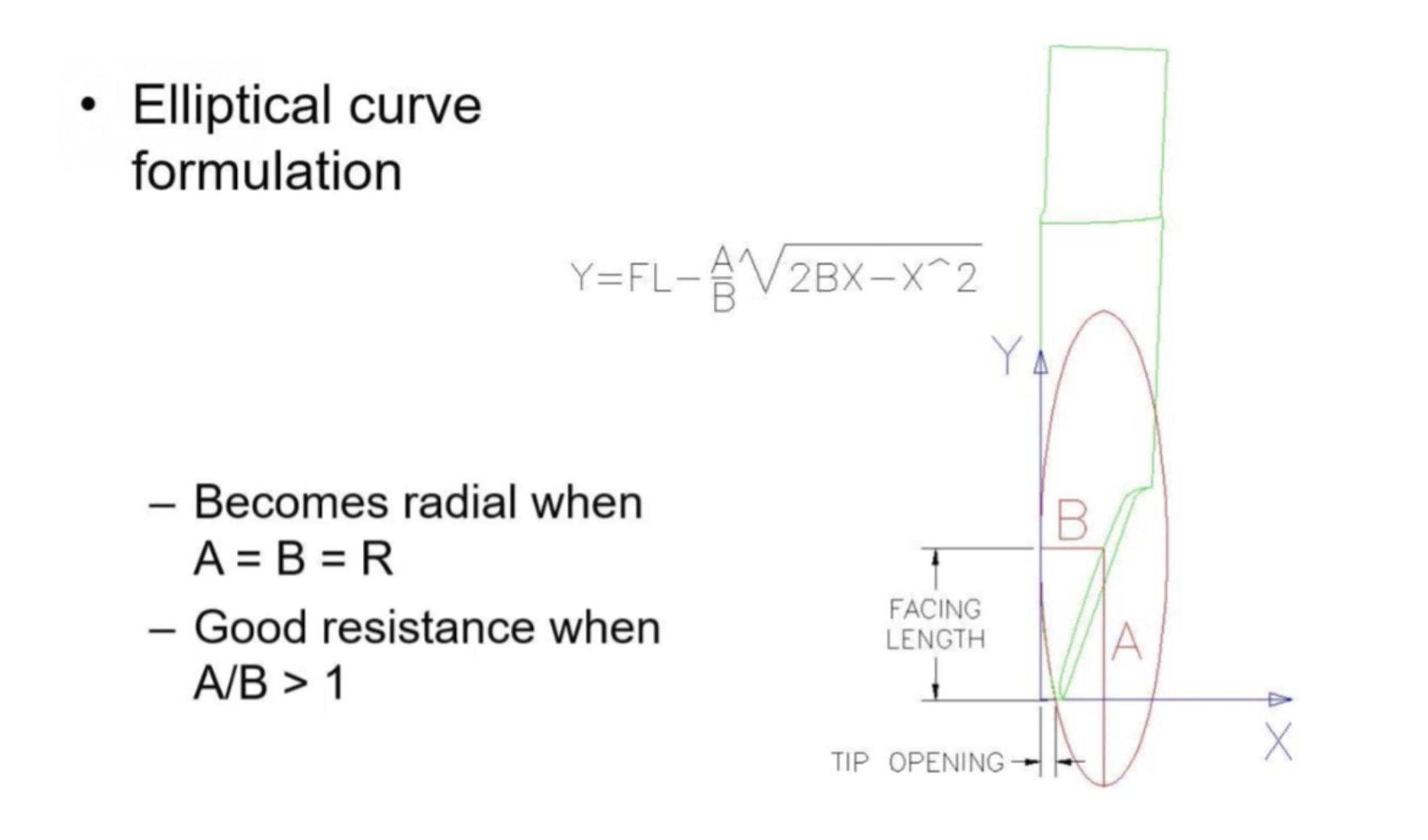
The term radial curve appears frequently as a descriptor for a simple constant-curvature curve. This usage is misleading. Radial describes a directional relationship to a radius, meaning something that radiates outward from a center point. It is a geometric relationship, not a curve type. A spoke on a wheel is radial. The curve itself is an arc. The geometrically accurate term for a constant-curvature facing curve is circular arc. It is fully described by a single parameter, the radius, and its curvature is uniform along its entire length. The clearest evidence for this correction comes from Bradbury’s own published work. In his 2009 presentation he uses the term radial curve throughout while simultaneously providing the mathematical proof that it is simply the limiting case of the elliptical family when A equals B equals R. The most rigorous practitioner in the field uses the conventional term while his own formula demonstrates it is not a distinct curve type at all but a special case of a more general family. That is the most honest possible illustration of the gap between working convention and geometric accuracy.
An elliptical curve is a meaningful departure from a circular arc, but only when its parameters are specified. An ellipse is defined by two semi-axes, conventionally a and b. When a equals b, the ellipse degenerates into a circle. A genuinely elliptical curve requires unequal semi-axes, and its behavior as a facing curve depends on three things, namely the value of a, the value of b, and which segment of the ellipse the facing occupies. Change any one of those and the curve behaves differently, even though it remains correctly described as elliptical. Claims of elliptical facing geometry without these parameters are geometrically incomplete and carry no predictive value. A circular arc is at least fully specified by one number. An elliptical curve requires at minimum two parameters plus segment location, and without them the word elliptical describes a mathematical family rather than a curve, which means two mouthpieces both described as elliptical could differ from each other more than either differs from a circular arc.
Bradbury has documented the elliptical curve formulation in a published 2009 presentation, “Introduction to Modern Mouthpiece Refacing Techniques.” The formula, diagram, and geometric orientation of the semi-axes are shown in Figure 1 below. In the diagram, B runs along the Y axis parallel to the facing length, and A runs along the X axis parallel to the tip opening. This is a specific and meaningful geometric specification that this author had claimed essentially never appeared in maker literature. That claim was incorrect, and the correction is credited to Bradbury. The formulation shows that when A equals B equals R the curve becomes a circular arc, establishing the circular arc as the limiting case of the elliptical family rather than a separate curve type.
Figure 1. Elliptical curve formulation and geometric orientation. Keith Bradbury, Introduction to Modern Mouthpiece Refacing Techniques, Mojo Mouthpiece Work LLC, 2009. Used with permission.
Bradbury’s presentation documents that increasing the A over B ratio above one adds blowing resistance by making the reed bend more steeply, without changing the facing length or tip opening. This is a precise and useful finding. The circular arc, corresponding to A over B equal to one, produces the most responsive and free-blowing result. Elliptical curves with higher A over B ratios add resistance deliberately and controllably. The choice between them is therefore not a question of which curve is geometrically superior but of what resistance profile a given player and context require.
Bradbury reports that after measuring several thousand mouthpieces, more of them are close to some form of ellipse than to a true circular arc. Notably, even mouthpieces machined to a circular arc specification frequently measure as a slight ellipse. His fitting approach uses a least squares solver to find the ellipse of best fit, treating an aspect ratio of approximately one as equivalent to a circular arc. This empirical finding suggests that the circular arc versus elliptical distinction is less sharp in manufactured mouthpieces than theoretical discussion implies.
Other curve families, including parabolic, hyperbolic, Bezier, and compound curves, represent additional options with different curvature distribution profiles. A parabolic curve is fully described by a single parameter and has continuously increasing curvature from heel to tip, making it more tractable for comparison than an ellipse. Bezier curves, common in CNC manufacturing, allow curvature to be tuned at specific points along the lay and subsume simpler curve types as special cases. Compound curves using different arc segments for different portions of the lay are documented in clarinet facing practice and reflect a pragmatic acknowledgment that a single curve type may not serve the full facing length equally well. Bradbury notes that he uses power curves with some clarinet facings, a practice he attributes to the published work of Stephen Fox, and reports that they can produce excellent altissimo response on clarinet, though he does not yet have a full mechanical account of why.
Reed Cut as an Open Question
The moving boundary framework raises a natural question about reed cut. Because reed cut determines the stiffness gradient along the vamp, two reeds with identical tip thickness but different vamp profiles will not bend the same way against the same curve. The stiffness encountered as the contact point travels along the lay differs between them, which means the effective stiffness profile generated during each oscillation cycle differs as well. The mechanical reasoning suggests that different cut profiles may pair more or less coherently with different curve geometries, and this is a hypothesis worth holding.
It is worth holding loosely, however. The model predicts a pairing tendency that should be visible in how experienced refacers actually work if it were functionally real and practitioners had converged on it empirically. Bradbury, who has measured several thousand mouthpieces across a wide range of players and contexts, reports that he has not observed any such pattern. That absence is a substantive check on the hypothesis, and it is credited to him. The reed cut pairing question remains open, mechanically motivated but empirically unconfirmed. The spectral content of these instruments is governed primarily by bore input impedance and the nonlinear flow relation at the reed, so any contribution from the precise interaction of cut and curve geometry is at most a second-order effect on a spectrum that is determined mostly elsewhere.
An Empirical Finding That Warrants Further Attention
Bradbury reports an observation from his refacing work that does not appear in the published literature and that has a plausible mechanical basis worth examining. He found that introducing a slight inversion of the facing curve in the tip rail area can improve and extend altissimo response. His diagnostic case was an alto Lakey mouthpiece that measured a tight inward curve at the tip and produced excellent altissimo but an airy tone in the regular range. By gradually removing the inversion, he arrived at a point where approximately ninety percent of it was gone, the tone cleared, and the altissimo response remained substantially improved. He describes this tip rail finishing adjustment as made by feel rather than measurement, and characterizes a typical result as extending altissimo range from one octave to one and a half octaves of accessible altissimo with equivalent effort.
The mechanical account of why this works is not yet established. The most plausible candidate explanation is that a slight inversion at the tip changes the closing dynamics of the reed at high frequencies by altering the contact force profile at the point where the reed channel is narrowest. This may influence the pressure pulse timing in ways that favor higher register resonances. That is a hypothesis rather than a confirmed mechanism, and it is the kind of thing that high-speed reed imaging synchronized with pressure measurement could in principle resolve. Bradbury acknowledges that he does not yet have a full explanation for the effect, and this author does not either.
What the Published Literature Actually Addresses
The peer-reviewed acoustic literature on single-reed woodwinds is substantial, and it is worth being specific about what it does and does not cover. The work of Dalmont, Gazengel, Chatziioannou, Backus, Thompson, Fletcher and Rossing, and the UNSW acoustics group addresses reed oscillation mechanics, oscillation thresholds, bore acoustics, reed mechanical modeling, and mouthpiece geometry effects in considerable depth. Reed parameters including effective stiffness, rest position, damping, and mass are well established as determinants of oscillation behavior. Tip opening has been experimentally shown to scale with oscillation threshold. Mouthpiece chamber and baffle geometry have received direct study, including 3D printing work by Carral, Lorenzoni, and Verlinden in which chamber and baffle shapes were varied systematically while radiated sound was measured. In that work the radiated spectral centroid remained nearly constant across substantial geometric changes, with the more meaningful differences appearing in blowing pressure and ease of playing rather than in the sound itself.
That finding is worth pausing on. Substantial changes to internal mouthpiece geometry produced mostly playability differences rather than spectral ones. It is a useful caution against attributing tonal results too readily to any single geometric variable, including the facing curve.
Most of these studies treat the mouthpiece as a system defined by aggregate parameters, specifically tip opening and reed stiffness, with the detail of the facing curve abstracted away entirely. Facing curve shape as an independent acoustic variable has not, as far as this author has been able to determine, been the subject of any peer-reviewed study that isolates it as an experimental variable with measured acoustic outcomes. The studies that vary mouthpiece geometry vary the chamber, baffle, and tip opening. The curve shape disappears into the model. If a study exists that treats curve geometry as a controlled independent variable, it has not been located, and the correction would be welcomed.
This absence matters. It means that confident claims about the acoustic superiority of a specific curve geometry, whether from makers, refacers, forum discussions, or prior iterations of this author’s own commentary, are operating beyond the published evidence. The moving boundary framework establishes that curve geometry can matter in principle, because it governs the time-varying stiffness of the reed throughout each cycle. It does not tell us which curve is preferable, for which reed, by how much, or whether differences between curve types are acoustically significant relative to the variance introduced by reed-to-reed variation in cane.
What Can Be Said
The most defensible claims about facing curve geometry are also the least glamorous ones. Smoothness and continuity of the curve along its length matters more than its mathematical family, because abrupt inflections create inconsistent contact forces and unpredictable reed seating. Left-to-right symmetry is functionally important and directly measurable, and asymmetry introduces torsional reed behavior that no curve geometry can compensate for. Facing length and tip opening together constrain the useful range of curve shapes more than curve geometry alone, because they set the displacement amplitude within which the reed operates and scale the oscillation threshold the player must overcome.
The experiment that would begin to answer the curve geometry question properly would require synthetic reeds or carefully matched cane batches to hold reed mechanical properties constant, systematic independent variation of curve geometry across otherwise identical mouthpieces, and dynamic measurement of reed displacement using established techniques such as laser vibrometry or stroboscopic digital image correlation, synchronized with mouthpiece pressure measurement. The tools exist. The study, as far as this author can determine, has not been done.
Until it is, the honest position is that the facing curve is a moving boundary condition with a well-grounded physical rationale for mattering, a community of practitioners holding strong and often contradictory opinions about how it matters, and no controlled experimental evidence establishing which curve geometry is preferable for any given reed profile or playing context. Bradbury, with more empirical exposure to this question than perhaps anyone working today, characterizes his own practice as an art informed by measurement, player history, and incremental adjustment from a known reference point rather than by a fixed rule. That description is more honest than most of what appears in the mouthpiece literature, and it is a more useful model for thinking about what the facing curve can and cannot be predicted to do.
The author thanks Keith Bradbury of Mojo Mouthpieces for his generous correspondence, for specific corrections incorporated into this essay, and for sharing empirical observations that do not yet appear in the published literature. Any remaining errors are the author’s own.
Bibliography
Bradbury, K.W. (2009). Introduction to Modern Mouthpiece Refacing Techniques. Mojo Mouthpiece Work LLC. Presentation slides available at slideplayer.com/slide/14345438.
Bradbury, K.W. (2020). How to Use the MojoMP Elliptical Facing Excel Spreadsheet. YouTube, timestamp 5:00. Available at youtube.com/watch?v=JbCqr12elno.
Carral, S., Lorenzoni, V., and Verlinden, J. (2015). Influence of mouthpiece geometry on saxophone playing. Proceedings of the Third Vienna Talk on Music Acoustics.
Dalmont, J.P., Gilbert, J., and Ollivier, S. (2003). Nonlinear characteristics of single-reed instruments: Quasistatic volume flow and reed opening measurements. Journal of the Acoustical Society of America, 114, 2253–2262.
Dalmont, J.P., Gilbert, J., Kergomard, J., and Ollivier, S. (2005). An analytical prediction of the oscillation and extinction thresholds of a clarinet. Journal of the Acoustical Society of America, 118, 3294–3305.
Fletcher, N.H. and Rossing, T.D. The Physics of Musical Instruments. Springer.
Gazengel, B. and Dalmont, J.P. (2011). Mechanical response characterization of saxophone reeds. Proceedings of Forum Acusticum, Aalborg, Denmark.
Ozdemir, M., et al. (2021). Towards 3D printed saxophone mouthpiece personalization: Acoustical analysis of design variations. Acta Acustica, 5, 46.
Thompson, S.C. (1979). The effect of the reed resonance on woodwind tone production. Journal of the Acoustical Society of America, 66(5), 1299–1307.
For decades I believed my idealized tonal concept was a myth. Not a destination I had not yet reached, but something structurally unreachable, a mythical sound that existed only in my mind and would stay there. I understood the acoustics. I had studied under one of the finest mouthpiece craftsman of his generation. I had spent years refacing, measuring, and writing about the physics of sound production on the saxophone. Not much of it closed the gap between what I heard in my head and what came out of the horn.
Then I played the new Otto Link Tone Edge.
The gap closed. Not because the mouthpiece added something I was missing, but because it stopped subtracting. What I put in came back to me without editorial comment, without compensation, and without correction. The tonal concept I had spent 35 years chasing was mine all along. The Tone Edge simply got out of the way long enough for me to hear it.
This essay is an attempt to explain how and why. It covers the acoustic character of the hard rubber Tone Edge and the diagnostic function that makes it uniquely valuable across every level of player development, from the middle school jazz band student encountering the tenor saxophone for the first time to the most elite professional working today. The argument is not that the new Tone Edge is a great mouthpiece among many. The argument is that it is the tenor saxophone mouthpiece, the foundational design against which every other piece should be measured, whether its players know it or not.
A note on perspective: this essay attempts objectivity, but the author will be direct. The response to this mouthpiece has been visceral and immediate in a way that is difficult to fully separate from the analysis. The reader should weigh that accordingly.
What Doc Knew
The piece reviewed here is the product of a manufacturing partnership between Theo Wanne and JJ Babbitt, announced in 2026, and represents the most recent expression of the Tone Edge lineage.
The diagnostic property of this Tone Edge was not discovered recently. My mentor, Dr. Paul “Doc” Tenney, spent his career reaching toward exactly this kind of design. His Jazzmaster mouthpiece reflected the same philosophy, neutral geometry, unmediated response, and no chops in a box. It was as close as he got. The new Tone Edge is closer still. If Doc were with us today, this is almost certainly the piece he would be playing.
In many ways this Tone Edge is the idealized realization of what Doc Tenney was reaching toward with the Jazzmaster. He never got all the way there, but this piece does. For those of us who studied under him, played his work, and carried his ideas forward, that is not a small thing. It is, frankly, emotionally profound.
The refinement process behind this generation of the Tone Edge reflected a genuine collaborative effort. Theo Wanne’s deep knowledge of Otto Link design and his ability to synthesize decades of player feedback into mouthpiece geometry defined the direction. At JJ Babbitt, Chris French updated the Otto Link molds and machinery while Bryan Vance oversaw system process improvements and Steve and Trace Rorie implemented all physical and process changes on the factory floor. Matt Ambrose brought technical CNC execution to the work, and Thomas Harris and Chris contributed the sensibilities of experienced players to the design process. The result is a mouthpiece that represents not one person’s vision but a shared commitment to getting the design right, no matter what it takes.
No Flattery
The Otto Link Tone Edge is not a mouthpiece that flatters its player. It does not add brightness, projection, or apparent power independent of player input. It does not compensate for insufficient air support, embouchure tension, or a poorly configured vocal tract. What it does instead is reflect each of those variables back to the player without correction or embellishment.
This is not a limitation. It is the source of the mouthpiece’s foundational status. A design that returns exactly what the player puts in serves every level of development with complete fidelity. The middle school player receives an honest account of where they are, the advancing player receives a precise diagnostic of what still needs work, and the elite professional receives the tonal concept they have spent a career building toward. Same mouthpiece, same geometry. Different players, different outcomes, all exactly right.
Three player-input variables are directly exposed by the Tone Edge. Air support governs the driving pressure at the reed and determines whether the player is exciting the bore’s resonance modes efficiently. Insufficient support produces a thin, unstable, or underpowered response. On a mouthpiece with an aggressive baffle or constrained chamber, that deficiency is partially masked. On the Tone Edge it is not.
Embouchure tension determines whether the reed can vibrate freely through its full amplitude envelope. Any excess clamping shifts the effective tip opening and damps upper partials. A forgiving mouthpiece absorbs some of that interference. The Tone Edge does not.
Vocal tract configuration, encompassing tongue arch, throat shape, and oral cavity volume, modifies the upstream impedance and interacts directly with reed behavior. A well-tuned vocal tract reinforces the reed’s resonance. A poorly tuned one fights it. Mouthpieces that impose strong spectral character of their own can obscure this interaction entirely. The Tone Edge cannot.
One important clarification is necessary. The Tone Edge does not deliver an idealized tone to every player. No mouthpiece played in real time can, since the sound a player perceives while playing is a composite of bone conduction, room acoustics, and direct sound, none of which matches what a listener or recording captures. What the Tone Edge delivers is an unmediated status check on player input. For the player who has done the work, that status check confirms something remarkable. The tone was always theirs. The Tone Edge simply returned it.
Doc Tenney was fond of saying it was not chops in a box. Playing the Tone Edge recalled those words immediately.
The Blank Canvas
The Tone Edge is a blank canvas that allows the player to define every tonal element they want to feel, hear, and emphasize. It does not add anything, and it reflects exactly what the player puts into it without biasing the output harmonically for projection purposes.
I can focus the tonal shape or spread it, and the response is completely even from top to bottom of the horn. The dynamic range is exhilarating, and the response characteristics are neither fast nor slow. They meet the player where the player is.
There is no upper partial embellishment and no chops in a box, just a canvas that invites the player to craft their own unique tonal identity.
The Otto Link Tone Edge is my Platonic ideal of what a tenor saxophone mouthpiece should be, and every other design is a departure from that ideal. The Tone Edge is the ideal itself, and for the player who has done the work, it delivers the tone they always had. That has always been enough.
Further Reading
For related reading on the mouthpieces produced through this partnership:
I have owned Ishimori products for years including their ligatures, thumb hook, thumb rest, and neck joint screw. I have played their saxophones and recommended them without hesitation to students and colleagues. If you are looking for a Taiwanese-manufactured saxophone set up with genuine care and precision, the Wood Stone line deserves serious consideration. The instruments are exceptional.
I say this because what follows is not a complaint from a dissatisfied customer. It is an observation from an admirer who has learned to separate two things Ishimori does simultaneously and unequally well. They manufacture with extraordinary care. And they market accessories with claims that have no physical basis.
The accessories are beautiful. That is not a minor point. Ishimori produces some of the finest small-scale metalwork in the saxophone world. Their ligatures are jewelry. Their thumb hook is machined to a standard that shames most instrument manufacturers. If you want to own a saxophone accessory that will outlast you and look extraordinary doing it, Ishimori is a reasonable place to spend your money.
The rest of this essay documents exactly where that stops being true.
One Question
Ishimori sells accessories across four categories that are relevant here, ligatures, thumb hooks, thumb rests, and neck joint screws. Each category carries acoustic claims in the product copy. Those claims share a common structure. Ishimori says each physical property of the accessory, whether material, finish, mounting method, or alloy, produces a specific and describable change in tone, response, resonance, or playability.
To evaluate those claims, one question is sufficient. Is there a physical pathway by which this property could influence the acoustic system?
The acoustic system of a saxophone is not the instrument body. It is the air column inside the bore, driven by reed oscillation at the mouthpiece end and radiating from the tone holes and the bell. Variables that directly affect that system, including mouthpiece geometry, reed characteristics, vocal tract configuration, and embouchure, produce real and measurable differences in the radiated sound. Variables that do not interact with the air column or the reed-mouthpiece interface cannot affect it regardless of the material they are made from or the finish applied to their surface.
With that framework in place, the Ishimori accessory line can be examined in sequence. The sequence is instructive. Each product sits further from the acoustic system than the last, and each carries claims of comparable or greater magnitude.
The Ligature
The ligature is the product most players associate with acoustic claims, and Ishimori’s Standard line is among the most explicit examples in the industry. The company offers the line in twelve material and finish combinations. Brass, copper, solid silver, and variants of each with gold plate, pink gold plate, and brushed satin finishes. Ishimori assigns each combination a specific position on a two-axis chart mapping brightness and resistance.
The chart is worth pausing on. Most accessory marketing keeps its claims in prose, where adjectives like warm and focused are slippery enough to survive scrutiny. Ishimori committed to coordinates. Brass with Gold Plate sits in the bright, less resistant quadrant. Copper with Pink Gold Plate sits in the more resistant, bright quadrant. Solid Silver with Pink Gold Plate is the darkest and most resistant option available. The plating, a surface treatment measured in microns, is doing independent acoustic work in this framework, shifting both axes simultaneously relative to the unplated base material.
The ligature contacts the mouthpiece body and holds the reed against the table. Its mechanical function is to maintain consistent reed contact pressure without impeding reed vibration. A ligature that does this reliably is a good ligature. The material it is made from and the finish applied to its surface have no pathway into the acoustic system. They cannot alter the impedance conditions the reed operates within. They cannot shift the brightness or resistance of the instrument’s response.
The Kodama II appears on the same chart, plotted as dark and less resistant. In a controlled blinded trial published on this site, two players evaluated five clarinet ligatures across two sessions without knowing which they were playing. For the initial trial, the Kodama II was consistently identified by feel and not by sound. The chart claims a specific tonal position. Numerous subsequent trials further demonstrated no tonal distinction. Those two findings cannot both be correct.
The Neck Joint Screw
The neck joint screw is the second exhibit, and in some respects the most clarifying one. It is a small fastener that secures the neck to the body of the instrument. Unlike the thumb rest and thumb hook that follow, it sits at a location that is genuinely functional. A poorly fitted or loose neck joint can compromise the air seal between neck and body, and that is acoustically relevant. Ishimori could have made a legitimate claim about precision fitting and airtightness. They did not.
The copy reads in full. ISHIMORI Wind Instruments invented the innovative screw made from alloyed silver. The flow of the phrase gets much better with this screw. The high notes become richer and powerful. You will be surprised to find that such a small screw improve drastically your sound and play.
There is no mention of fit, airtightness, or mechanical precision. The claim is entirely material-based. Alloyed silver produces better phrase flow and a richer, more powerful upper register. The screw’s functional role at the neck joint is not the argument. The argument is that silver alloy as a material improves the sound.
Jim Corry’s endorsement on the thumb hook page, cited below, adds a detail that deserves its own moment. Before purchasing the thumb hook, he bought both the silver neck screw and a silver lyre screw, and reported that they totally transformed the tone and feel of his Mark VI. A lyre screw is a bracket attachment point for a marching lyre. It is present on the instrument body and contacts nothing in the acoustic system under any playing condition whatsoever. No air passes through it. No reed touches it. No part of the bore interacts with it. Its material cannot affect the radiated sound by any physical mechanism. Ishimori sells it in silver. Players report transformation.
The Thumb Rest
The thumb rest extends the argument one step further in two directions simultaneously. It moves further from the acoustic system, supporting the left thumb on the back of the instrument body at a location more remote from the reed and air column than the neck joint screw, and it introduces a new category of claim, the vintage authenticity argument.
Ishimori offers the thumb rest in two versions. The metal version claims to give your sound more resonance together with better response and intonation. The mechanism is again the body vibration argument. Glue-mounted thumb rests are said to dampen saxophone vibration, while the Wood Stone screw-mounted version does not reduce vibration and realizes better response and more resonance. The same claim made for the neck joint screw is restated here for a component on the back of the instrument body, with intonation now added to the list of properties improved.
The hard rubber version makes a different and more ambitious claim. It is modeled after the thumb rests used on early Mark VI saxophones produced between 1954 and 1960, and the copy states that those thumb rests contributed to the dark and rich sound of that time. Installing the Wood Stone Hard Rubber Thumb Rest will allow you to experience the legendary sound of old Mark 6 saxophones.
This is the vintage mythology argument in its most concentrated form. A component that supports the left thumb on the back of the instrument body is offered as the mechanism by which the celebrated sound of the early Mark VI can be accessed. The causal chain is stated plainly. Thumb rest material determines tonal character. The 1954 to 1960 production window was sonically exceptional because of what players were resting their left thumbs on.
The early Mark VI’s reputation rests on its bore geometry, pad work, and the players who happened to use it during a remarkable period in jazz history. The thumb rest material is not a variable that appears anywhere in the acoustics literature on that instrument.
The Thumb Hook
The thumb hook is the final exhibit, and it forecloses any remaining interpretive generosity. The ligature at least contacts the mouthpiece, which contacts the reed. A reader inclined to be generous could imagine, however implausibly, some transmission pathway. The neck joint screw sits at a genuinely functional location. The thumb rest at least mounts to the instrument body. The thumb hook is a curved bracket on the back of the body that supports the right thumb. It contacts no part of the acoustic system at any point.
Ishimori’s copy claims the thumb hook improves response and the resonance of the instrument and makes it possible to control sound volume easily in the whole range. The mechanism offered is that the narrow contact surface of the hook against the body does not prevent the vibration of the saxophone. The implication is that the stock thumb hook damps body vibrations that contribute to tone, and that the Wood Stone hook restores them.
This requires the saxophone body to function as an acoustic resonator whose vibrations contribute meaningfully to the radiated sound. It does not. The body vibrates because acoustic energy inside the bore induces sympathetic vibration in the brass walls. That vibration is a consequence of the acoustic field, not a contributor to it. Modifying it has no measurable effect on the radiated sound or tonal color reaching the room. Ishimori’s claims are about exactly those properties, and the marketing does not distinguish between what a player might feel through tactile feedback and what an audience actually hears.
The endorsement copy on this page is among the most useful in the Ishimori catalog. Bob Franceschini reports a richness to the bottom half of the horn he never heard or felt before. Jim Corry describes his sound as opened up. These are real perceptual experiences reported by serious players. They are also precisely what confirmation bias predicts will happen when an expectant player installs a premium accessory and sits down to play.
The most instructive quote comes from Tatsuya Sato, in his own words on the product page: “If there are players out there who are dissatisfied with their horn, or people who just can’t seem to get rid of that nagging feeling inside no matter what mouthpiece or reed they try, then this is the part for you.”
That sentence identifies the target customer with unusual honesty. It is the player who has already exhausted the high-signal variables without satisfaction. The proposed solution is a thumb hook.
This is where the sequence arrives. From ligature plating to neck joint screw alloy to thumb rest material to thumb hook mounting, each step has moved further from the acoustic system while the claims have remained constant in magnitude. The right thumb hook will open up your resonance across the full range. The left thumb rest will give you the Mark VI sound. The screw that holds the neck to the body will dramatically improve your sound. The plating on your ligature will shift your position on a two-axis tonal map.
Ishimori did not invent this approach. They systematized it, documented it with unusual explicitness, and applied it to a product line of exceptional physical quality. The craftsmanship is genuine. The acoustic claims are not. That combination of real quality and unfounded claims is what makes the catalog so effective and so worth examining carefully.
A Pattern, Not an Outlier
Ishimori is not an outlier. The accessory market across the saxophone industry runs on the same mechanism. The industry assigns tonal significance to physical properties that cannot interact with the acoustic system, through artist endorsement and product copy. What makes Ishimori useful as a case study is not that they are worse than their competitors. It is that they are more explicit. The quadrant chart, the phrase flow claim, the Mark VI thumb rest, and the silver lyre screw are unusual in their specificity. Most manufacturers keep their language vague enough to be unfalsifiable. Ishimori committed to claims precise enough to examine, which is what makes them worth examining.
The broader pattern they represent is one saxophonists encounter at every price point and in every product category. The industry has learned that players who are dissatisfied with their sound will reach for a physical solution before a musical one, and it has built an extraordinarily efficient apparatus for meeting them there. Tatsuya Sato’s observation about players who cannot get rid of that nagging feeling no matter what mouthpiece or reed they try was not an accident. It is a market segment.
But beautiful objects and acoustically significant objects are not the same thing, and there is no obligation to pretend otherwise. I have kept several Ishimori accessories and sold the rest. I will likely buy more. They are the finest bling in the saxophone world, and I mean that without irony. If you want to own something beautifully made that you will still be handing down in fifty years, Ishimori is a reasonable place to spend your money.
Just don’t expect it to change your sound. Your sound is your problem, and no amount of alloyed silver is going to solve it.
In a previous trial documented on this site, my colleague and I compared five clarinet ligatures under blinded conditions and found that four were indistinguishable by sound or feel. The fifth, the Ishimori Kodama II, stood out consistently enough that I advanced a hypothesis about its wooden reed plate as a proprioceptive mechanism. This follow-up trial, conducted with greater methodological rigor and a substantially expanded ligature set, contradicts that hypothesis and produces a cleaner overall result.
A Note on Limitations
This was again a careful informal trial rather than a formal experiment. Two players is a small sample, and our perceptions are subjective and difficult to quantify. We did not record audio for acoustic analysis. The results are suggestive rather than conclusive, and replication with more players would strengthen any conclusions drawn here. That said, the protocol improvements over the first trial give us greater confidence in these findings than in the previous ones.
The Trial
The same two players from the first trial participated. We tested eleven ligatures on the same mouthpiece and Legere reed used in the previous trial, blindfolded, with each ligature played three times in randomized order. One player was blindfolded at a time while the other managed ligature changes, and roles were swapped.
The ligatures were the Bonade Inverted Black Nickel, Bonade Inverted Gold Plate, D’Addario H, Ishimori Kodama II, Rovner LGX, Rovner Light, Rovner Versa, Selmer Paris Two Screw, Yamaha Two Screw, and Yanagisawa Yany Sixs.
The key methodological improvement over the first trial was tension control. For each ligature, we established minimum viable clamping force, meaning the least tension necessary to secure the reed at a set contact point without the tip moving laterally. We then played from that baseline and incrementally increased tension. For two-screw ligatures, we tensioned the top screw only. This protocol ensured we were not inadvertently comparing ligatures at arbitrary or inconsistent tension levels, which we believe compromised the first trial in at least one case, discussed below.
Results
Neither player could detect any tonal difference among any of the eleven ligatures at any point during the session. This null result was consistent and unambiguous.
We also found no detectable resistance differences across the tension range for any ligature.
The one area where ligatures differed was articulatory controllability. At minimum viable tension, the Rovner Versa and Rovner LGX produced noticeably more consistent and controllable articulation than the remaining nine. This perceived difference was proprioceptive only. It was not audible. The Rovner Light was not reliably detectable above chance.
All three Rovner ligatures demonstrated a second practical advantage. When rotating the mouthpiece for tuning adjustments, the reed remained stable and did not shift position. Every other ligature allowed the reed to rotate with the mouthpiece during this adjustment.
The Yanagisawa Yany Sixs occupied a distinct position. It required more tensioning than the other metal ligatures to achieve reed security, owing to its design: four hard rubber spacers contact the mouthpiece body while gold plated brass points contact the reed. Once the reed was secured, articulation was at its best and declined with any additional tension. The other metal ligatures showed a small productive tension range, improving with modest additional tension before degrading. The Yany had no such range. Its optimal point was its minimum viable tension, and additional clamping force immediately diminished performance. This is consistent with its point contact geometry on the reed, which concentrates clamping force precisely enough that over-constraint follows quickly once stability is achieved.
All other ligatures, including the Kodama II, were indistinguishable from one another in every respect.
Discussion
The null tonal result
The expansion from five to eleven ligatures, spanning a wide range of materials, masses, constructions, and price points, produced no tonal differentiation whatsoever. Metal ligatures of varying design, the Kodama II, and the Rovners all sounded identical. This is consistent with the mechanical role of the ligature, which is to secure the reed, and with the argument made elsewhere on this site that the upstream acoustic variables governing tone are entirely independent of ligature choice.
The Rovner finding
The Rovner Versa and LGX stood out for a specific and mechanically explicable reason. The mouthpiece table and reed table are both flat surfaces, which means clamping force distribution directly determines how uniformly those surfaces mate. The Rovners achieve broad continuous contact with both the reed surface and the mouthpiece body. This does two things simultaneously. It distributes clamping force across a large reed contact area rather than concentrating it at one or two points, and it uses the mouthpiece body itself as part of the stabilizing structure, reducing assembly movement independent of clamping force. The result is that reed stability is achieved at lower clamping force than narrow point-contact designs require.
This same contact geometry explains the tuning adjustment finding. When rotating the mouthpiece to adjust barrel position, all three Rovner ligatures held the reed in place because their broad wrap around the mouthpiece body resists rotational movement of the entire assembly. Narrow point-contact ligatures have no comparable resistance to that rotation, and the reed moves with the mouthpiece. This is not a minor convenience. A reed that shifts position during tuning requires resetting before playing, and resetting introduces its own variability. The Rovners eliminate that step.
Both advantages, articulatory stability at low clamping force and reed stability during mouthpiece rotation, stem from the same underlying mechanical property. The Rovners are more efficient reed-securing devices because their contact geometry does more stabilizing work across more degrees of freedom.
This is a reed-securing efficiency advantage, not a tonal one. Whether a player finds it meaningful depends on their setup habits and tolerance for reed repositioning. The tonal claims the market makes for ligatures remain unsupported.
The Kodama II reversal
The first trial identified the Kodama II as consistently distinguishable and advanced a hypothesis that its wooden reed plate was delivering a qualitatively different proprioceptive signal. That hypothesis was wrong, and the error was methodological. In the first trial, the Kodama II’s leather body produced audible creaking under tension, which caused us to stop tensioning earlier than we did with other ligatures. It was being compared under-tensioned against properly tensioned alternatives. The sensation we attributed to the wooden plate was almost certainly reed instability from insufficient clamping force.
Over several weeks of use, the leather broke in and the creaking stopped, which allowed us to tension the ligature properly for the first time. In this trial, with tension controlled to minimum viable levels across all ligatures, the Kodama II produced no distinguishable result. Its reed plate contacts the reed along two narrow vertical rails rather than a continuous surface, which means that despite its unconventional appearance it functions mechanically as a narrow point-contact ligature. It belongs in the same category as the metal designs.
The prior hypothesis is retracted.
What the evidence supports
Eleven ligatures. No tonal differences. No resistance differences. The only detectable variables were articulatory stability at low clamping force and reed stability during mouthpiece rotation, and both were explained entirely by contact geometry. The claims routinely made for ligatures, including darkness, brightness, projection, resonance, and vibrancy, found no support across a morning of controlled testing. What the Rovner Versa and LGX demonstrated is that a ligature can be better or worse at securing a reed across a wider range of conditions. That is the only claim the evidence supports.