
Every saxophonist has noticed that changing a mouthpiece changes more than the sound. It changes how the reed feels, how it responds, and how hard the instrument asks you to work. Most players attribute this to tip opening or chamber geometry, and those things matter. But the facing curve, the shape of the lay against which the reed vibrates, is doing something more fundamental than most mouthpiece literature acknowledges, and more fundamental than this author has previously described with adequate precision.
The facing curve is not a static surface that the reed vibrates against. It is a moving boundary. As the reed deflects toward the table during each oscillation cycle, the point of contact travels along the facing curve, and the portion of the reed left free to vibrate shortens continuously. Because the stiffness of a beam in bending is inversely proportional to the cube of its free length, small changes in that free length produce large changes in how stiff the reed is at any given moment. The facing curve geometry determines how that stiffness varies across the entire oscillation cycle, which is why two mouthpieces with the same tip opening but different curve geometries can feel and respond differently even when every other variable is held constant.
This has consequences for how the mouthpiece curve discussion should be conducted, including why confident claims about elliptical curves, parabolic curves, and radial curves so rarely survive scrutiny, and why the published acoustic literature offers less support for specific curve geometries than the mouthpiece world typically implies.
This essay was substantially improved through correspondence with Keith Bradbury of Mojo Mouthpieces, a mechanical engineer and the most knowledgeable expert in woodwind mouthpiece refacing working today. Bradbury has measured several thousand mouthpieces and developed both the analytical tools and the empirical framework used in the Mojo refacing practice. The tip rail inversion finding reported in this essay originates entirely with him and appears here with his permission. His corrections and observations are credited specifically throughout.
Why the Reed Is a Nonlinear Problem
The physics behind the moving boundary is worth stating carefully for readers who want the full mechanical picture. Others may proceed directly to the terminology section.
The reed behaves approximately as a clamped beam excited into its first bending mode. What distinguishes it from a simple vibrating surface is that one of its constraints moves. As the reed deflects toward the mouthpiece, it makes contact with the lay, and the point of contact travels along the facing curve as deflection increases. The effective vibrating length shortens as the reed closes and lengthens as it opens, and because stiffness scales with the cube of that length, the mechanical consequences are not small. The reed’s effective stiffness varies continuously throughout each oscillation cycle, and the facing curve geometry is what programs that variation.
The system is therefore nonlinear, and the nonlinearity is not incidental. It is what enables the reed to act as an oscillator and to generate the harmonic spectrum the instrument depends on. A different curve geometry produces a different stiffness-versus-deflection relationship, and therefore a different restoring-force profile across the cycle.
Two further forces complete the picture. The aerodynamic pressure difference across the reed drives it toward the table, and the lip supplies both a static loading force and a substantial damping term. The lip contribution is not a secondary detail. The published literature treats lip force and lip damping as dominant control parameters, and any honest account of reed motion must acknowledge that embouchure influences the effective damping of the system at least as strongly as the facing curve influences the effective stiffness. Isolating the curve while holding embouchure constant is exactly what controlled experiments would need to do, and it is also exactly what player-based assessments cannot do.
Curve Terminology Needs Correction
Much of the confusion in maker literature originates in imprecise nomenclature, and the imprecision appears not only in commercial materials but in practitioner forums and in prior commentary by this author.
The term radial curve appears frequently as a descriptor for a simple constant-curvature curve. This usage is misleading. Radial describes a directional relationship to a radius, meaning something that radiates outward from a center point. It is a geometric relationship, not a curve type. A spoke on a wheel is radial. The curve itself is an arc. The geometrically accurate term for a constant-curvature facing curve is circular arc. It is fully described by a single parameter, the radius, and its curvature is uniform along its entire length. The clearest evidence for this correction comes from Bradbury’s own published work. In his 2009 presentation he uses the term radial curve throughout while simultaneously providing the mathematical proof that it is simply the limiting case of the elliptical family when A equals B equals R. The most rigorous practitioner in the field uses the conventional term while his own formula demonstrates it is not a distinct curve type at all but a special case of a more general family. That is the most honest possible illustration of the gap between working convention and geometric accuracy.
An elliptical curve is a meaningful departure from a circular arc, but only when its parameters are specified. An ellipse is defined by two semi-axes, conventionally a and b. When a equals b, the ellipse degenerates into a circle. A genuinely elliptical curve requires unequal semi-axes, and its behavior as a facing curve depends on three things, namely the value of a, the value of b, and which segment of the ellipse the facing occupies. Change any one of those and the curve behaves differently, even though it remains correctly described as elliptical. Claims of elliptical facing geometry without these parameters are geometrically incomplete and carry no predictive value. A circular arc is at least fully specified by one number. An elliptical curve requires at minimum two parameters plus segment location, and without them the word elliptical describes a mathematical family rather than a curve, which means two mouthpieces both described as elliptical could differ from each other more than either differs from a circular arc.
Bradbury has documented the elliptical curve formulation in a published 2009 presentation, “Introduction to Modern Mouthpiece Refacing Techniques.” The formula, diagram, and geometric orientation of the semi-axes are shown in Figure 1 below. In the diagram, B runs along the Y axis parallel to the facing length, and A runs along the X axis parallel to the tip opening. This is a specific and meaningful geometric specification that this author had claimed essentially never appeared in maker literature. That claim was incorrect, and the correction is credited to Bradbury. The formulation shows that when A equals B equals R the curve becomes a circular arc, establishing the circular arc as the limiting case of the elliptical family rather than a separate curve type.
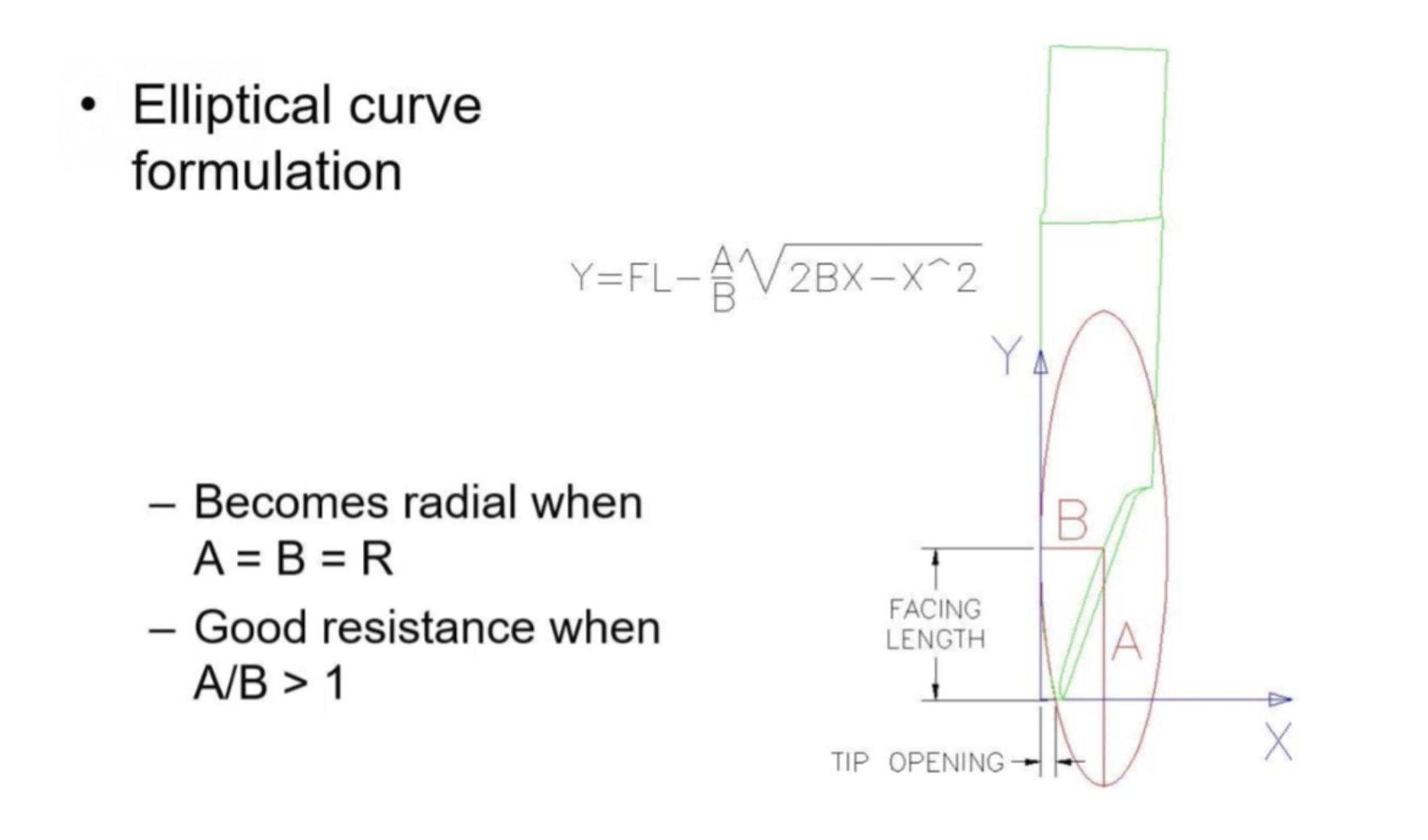
Bradbury’s presentation documents that increasing the A over B ratio above one adds blowing resistance by making the reed bend more steeply, without changing the facing length or tip opening. This is a precise and useful finding. The circular arc, corresponding to A over B equal to one, produces the most responsive and free-blowing result. Elliptical curves with higher A over B ratios add resistance deliberately and controllably. The choice between them is therefore not a question of which curve is geometrically superior but of what resistance profile a given player and context require.
Bradbury reports that after measuring several thousand mouthpieces, more of them are close to some form of ellipse than to a true circular arc. Notably, even mouthpieces machined to a circular arc specification frequently measure as a slight ellipse. His fitting approach uses a least squares solver to find the ellipse of best fit, treating an aspect ratio of approximately one as equivalent to a circular arc. This empirical finding suggests that the circular arc versus elliptical distinction is less sharp in manufactured mouthpieces than theoretical discussion implies.
Other curve families, including parabolic, hyperbolic, Bezier, and compound curves, represent additional options with different curvature distribution profiles. A parabolic curve is fully described by a single parameter and has continuously increasing curvature from heel to tip, making it more tractable for comparison than an ellipse. Bezier curves, common in CNC manufacturing, allow curvature to be tuned at specific points along the lay and subsume simpler curve types as special cases. Compound curves using different arc segments for different portions of the lay are documented in clarinet facing practice and reflect a pragmatic acknowledgment that a single curve type may not serve the full facing length equally well. Bradbury notes that he uses power curves with some clarinet facings, a practice he attributes to the published work of Stephen Fox, and reports that they can produce excellent altissimo response on clarinet, though he does not yet have a full mechanical account of why.
Reed Cut as an Open Question
The moving boundary framework raises a natural question about reed cut. Because reed cut determines the stiffness gradient along the vamp, two reeds with identical tip thickness but different vamp profiles will not bend the same way against the same curve. The stiffness encountered as the contact point travels along the lay differs between them, which means the effective stiffness profile generated during each oscillation cycle differs as well. The mechanical reasoning suggests that different cut profiles may pair more or less coherently with different curve geometries, and this is a hypothesis worth holding.
It is worth holding loosely, however. The model predicts a pairing tendency that should be visible in how experienced refacers actually work if it were functionally real and practitioners had converged on it empirically. Bradbury, who has measured several thousand mouthpieces across a wide range of players and contexts, reports that he has not observed any such pattern. That absence is a substantive check on the hypothesis, and it is credited to him. The reed cut pairing question remains open, mechanically motivated but empirically unconfirmed. The spectral content of these instruments is governed primarily by bore input impedance and the nonlinear flow relation at the reed, so any contribution from the precise interaction of cut and curve geometry is at most a second-order effect on a spectrum that is determined mostly elsewhere.
An Empirical Finding That Warrants Further Attention
Bradbury reports an observation from his refacing work that does not appear in the published literature and that has a plausible mechanical basis worth examining. He found that introducing a slight inversion of the facing curve in the tip rail area can improve and extend altissimo response. His diagnostic case was an alto Lakey mouthpiece that measured a tight inward curve at the tip and produced excellent altissimo but an airy tone in the regular range. By gradually removing the inversion, he arrived at a point where approximately ninety percent of it was gone, the tone cleared, and the altissimo response remained substantially improved. He describes this tip rail finishing adjustment as made by feel rather than measurement, and characterizes a typical result as extending altissimo range from one octave to one and a half octaves of accessible altissimo with equivalent effort.
The mechanical account of why this works is not yet established. The most plausible candidate explanation is that a slight inversion at the tip changes the closing dynamics of the reed at high frequencies by altering the contact force profile at the point where the reed channel is narrowest. This may influence the pressure pulse timing in ways that favor higher register resonances. That is a hypothesis rather than a confirmed mechanism, and it is the kind of thing that high-speed reed imaging synchronized with pressure measurement could in principle resolve. Bradbury acknowledges that he does not yet have a full explanation for the effect, and this author does not either.
What the Published Literature Actually Addresses
The peer-reviewed acoustic literature on single-reed woodwinds is substantial, and it is worth being specific about what it does and does not cover. The work of Dalmont, Gazengel, Chatziioannou, Backus, Thompson, Fletcher and Rossing, and the UNSW acoustics group addresses reed oscillation mechanics, oscillation thresholds, bore acoustics, reed mechanical modeling, and mouthpiece geometry effects in considerable depth. Reed parameters including effective stiffness, rest position, damping, and mass are well established as determinants of oscillation behavior. Tip opening has been experimentally shown to scale with oscillation threshold. Mouthpiece chamber and baffle geometry have received direct study, including 3D printing work by Carral, Lorenzoni, and Verlinden in which chamber and baffle shapes were varied systematically while radiated sound was measured. In that work the radiated spectral centroid remained nearly constant across substantial geometric changes, with the more meaningful differences appearing in blowing pressure and ease of playing rather than in the sound itself.
That finding is worth pausing on. Substantial changes to internal mouthpiece geometry produced mostly playability differences rather than spectral ones. It is a useful caution against attributing tonal results too readily to any single geometric variable, including the facing curve.
Most of these studies treat the mouthpiece as a system defined by aggregate parameters, specifically tip opening and reed stiffness, with the detail of the facing curve abstracted away entirely. Facing curve shape as an independent acoustic variable has not, as far as this author has been able to determine, been the subject of any peer-reviewed study that isolates it as an experimental variable with measured acoustic outcomes. The studies that vary mouthpiece geometry vary the chamber, baffle, and tip opening. The curve shape disappears into the model. If a study exists that treats curve geometry as a controlled independent variable, it has not been located, and the correction would be welcomed.
This absence matters. It means that confident claims about the acoustic superiority of a specific curve geometry, whether from makers, refacers, forum discussions, or prior iterations of this author’s own commentary, are operating beyond the published evidence. The moving boundary framework establishes that curve geometry can matter in principle, because it governs the time-varying stiffness of the reed throughout each cycle. It does not tell us which curve is preferable, for which reed, by how much, or whether differences between curve types are acoustically significant relative to the variance introduced by reed-to-reed variation in cane.
What Can Be Said
The most defensible claims about facing curve geometry are also the least glamorous ones. Smoothness and continuity of the curve along its length matters more than its mathematical family, because abrupt inflections create inconsistent contact forces and unpredictable reed seating. Left-to-right symmetry is functionally important and directly measurable, and asymmetry introduces torsional reed behavior that no curve geometry can compensate for. Facing length and tip opening together constrain the useful range of curve shapes more than curve geometry alone, because they set the displacement amplitude within which the reed operates and scale the oscillation threshold the player must overcome.
The experiment that would begin to answer the curve geometry question properly would require synthetic reeds or carefully matched cane batches to hold reed mechanical properties constant, systematic independent variation of curve geometry across otherwise identical mouthpieces, and dynamic measurement of reed displacement using established techniques such as laser vibrometry or stroboscopic digital image correlation, synchronized with mouthpiece pressure measurement. The tools exist. The study, as far as this author can determine, has not been done.
Until it is, the honest position is that the facing curve is a moving boundary condition with a well-grounded physical rationale for mattering, a community of practitioners holding strong and often contradictory opinions about how it matters, and no controlled experimental evidence establishing which curve geometry is preferable for any given reed profile or playing context. Bradbury, with more empirical exposure to this question than perhaps anyone working today, characterizes his own practice as an art informed by measurement, player history, and incremental adjustment from a known reference point rather than by a fixed rule. That description is more honest than most of what appears in the mouthpiece literature, and it is a more useful model for thinking about what the facing curve can and cannot be predicted to do.
The author thanks Keith Bradbury of Mojo Mouthpieces for his generous correspondence, for specific corrections incorporated into this essay, and for sharing empirical observations that do not yet appear in the published literature. Any remaining errors are the author’s own.
Bibliography
Bradbury, K.W. (2009). Introduction to Modern Mouthpiece Refacing Techniques. Mojo Mouthpiece Work LLC. Presentation slides available at slideplayer.com/slide/14345438.
Bradbury, K.W. (2020). How to Use the MojoMP Elliptical Facing Excel Spreadsheet. YouTube, timestamp 5:00. Available at youtube.com/watch?v=JbCqr12elno.
Carral, S., Lorenzoni, V., and Verlinden, J. (2015). Influence of mouthpiece geometry on saxophone playing. Proceedings of the Third Vienna Talk on Music Acoustics.
Dalmont, J.P., Gilbert, J., and Ollivier, S. (2003). Nonlinear characteristics of single-reed instruments: Quasistatic volume flow and reed opening measurements. Journal of the Acoustical Society of America, 114, 2253–2262.
Dalmont, J.P., Gilbert, J., Kergomard, J., and Ollivier, S. (2005). An analytical prediction of the oscillation and extinction thresholds of a clarinet. Journal of the Acoustical Society of America, 118, 3294–3305.
Fletcher, N.H. and Rossing, T.D. The Physics of Musical Instruments. Springer.
Gazengel, B. and Dalmont, J.P. (2011). Mechanical response characterization of saxophone reeds. Proceedings of Forum Acusticum, Aalborg, Denmark.
Ozdemir, M., et al. (2021). Towards 3D printed saxophone mouthpiece personalization: Acoustical analysis of design variations. Acta Acustica, 5, 46.
Thompson, S.C. (1979). The effect of the reed resonance on woodwind tone production. Journal of the Acoustical Society of America, 66(5), 1299–1307.
Further Reading at Jazzocrat
The Otto Link Tone Edge: What the Mirror Reveals
The Primacy of Response: Rethinking the Saxophonist in the Acoustic System
Leave a Reply